 EN
EN  SE
SE 
Defence sector: Industrial scale and capacity, order intake and lower valuations.
The Finserve Global Defence & Security Fund rose by 2.37 % in August (R EUR 1.29 %). Against a backdrop of continued strong order intake, improved margins and estimates, forward-looking valuations continue to fall. We can also see that earnings growth is rising steadily, whilst share prices in the sector are characterised by high volatility and weaker performance than previously. The strongest performance during the month was in the cyber security sector, whilst the weakest was among US defence companies.
Volatility is characterised by sector rotation, developments in active conflicts and their valuation assessments. Growth within defence has a low correlation with the general stock market and technological development, and is driven more by demand for long-term defence capability and the conditions for financing it. Valuations were touched upon in the previous report and the team's specific report on the sector here: https://finserve.se/starka-halvarsrapporter-visar-vilka-som-kan-leverera-andra-halvan-av-2026/
The diagram below shows further lower Price/Sales valuations and, as mentioned above, stable earnings growth that is not reflected in the sector's share price performance.
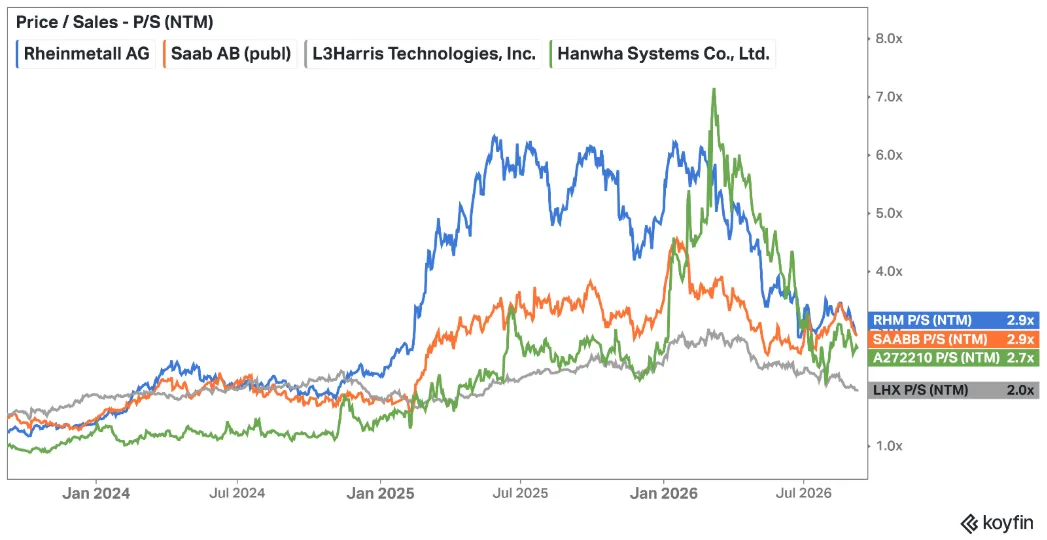
RRM – Rheinmetall, SAABB – SAAB, LHX – L3Harris, A272210 – Hanwha Systems
Source: S&P IQ & Koyfin
Past performance should not be interpreted as a forecast of future returns.
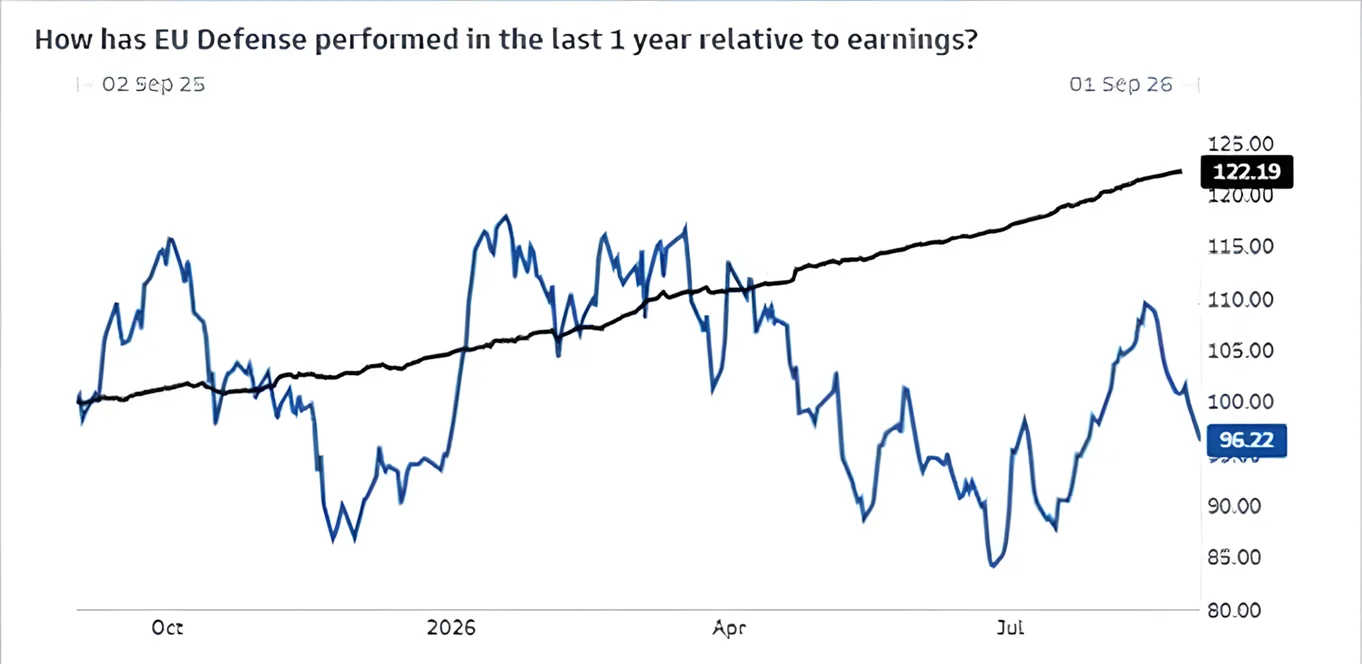
* GSSBDEFE Px – GSSBDEFE EPS
Source: Goldman Sachs
Past performance should not be interpreted as a forecast of future returns.
Ukraine: negotiation track with continued major differences
In August, Ukraine presented new proposals to American negotiators. On 25 August, Zelenskyy outlined a framework drawn up together with American and European representatives featuring ideas for a ceasefire, an economic zone in the Donbas, and the future role of the EU and NATO in securing the zone. At the same time, Moscow questioned the feasibility of allowing a third party to administer such a zone and maintained its territorial claims. This once again shows that Russia has no intention of achieving a ceasefire.
Our assessment is that negotiations could create short-term movements in defence shares. However, we see limited conditions for a ceasefire in itself to remove Europe's need for rearmament. A sustainable agreement needs to be supported by credible security guarantees, a strong Ukraine and European capability to deter new attacks. Even a more positive diplomatic scenario and ceasefire would therefore require significant defence investments. In reality, the threat may increase in certain regions, along with an increased number of hybrid attacks. Crucial for the defence industry will be to meet these needs with increased cybersecurity, production, shorter lead times and increased cooperation.
In line with most experts in the field, we consider that diplomacy and peace talks are most effective together with hard economic sanctions, strategic pressure and the demonstration of strong defence capability. This speaks in favour of long-term rearmament regardless of developments.
Iran: developments reinforce the need for European responsibility
The conditions for a stable agreement with Iran on the part of the US deteriorated during the month. The deadline that had been set in June passed without a final agreement. On 30 August, the US carried out new attacks against what the US military stated were Iranian launch systems by the strait. Iran stated that the country responded with attacks against US forces in the region. The events marked the first major direct attacks between the parties in just over a month.
We also see a clear European dilemma in this conflict: when the US needs to allocate resources to the Middle East, the value of Europe being able to shoulder a greater share of the responsibility for its own security increases.
Overall, we are seeing an increased and immediate shortage of defence materiel in Europe, North America and also in APAC. There is a clear strategy among allied antagonists to pursue a strategy of attrition where the West has a distinct shortage of critical defence materiel. In Ukraine, there is an acute shortage of Patriot interceptors, which is hampering the defence against Russian ballistic missiles. This demonstrates how crucial the availability of ammunition is for already installed defence systems to be able to provide sustained protection.
Companies with the highest and lowest performance during August 2023
| August 2026 – Highest development | August 2026 – Lowest performance | ||
| Electro Optic Systems | 47% | Curtiss-Wright | -20% |
| Satellogic | 36% | A10 Networks | -14% |
| Bittium | 30% | Howmet Aerospace | -13% |
| NextNav | 21% | OHB | -11% |
| CrowdStrike | 21% | Kraken Robotics | -11% |
Company-specific news
Our report from July presented the positive signals from the Q2 reports, which showed increased investments in production capacity, stronger margins, and that the majority of companies beat estimates, some significantly. The companies also continue to receive strong order intake.
RTX secured a seven-year contract worth $22.9 billion for Tomahawk missiles and associated support for the US Navy. The contract supports a ramp-up to over 1,000 missiles per year. We view this announcement as a concrete example of how the need to replenish military stockpiles is being translated into long-term industrial commitments.
Hanwha announced during the month that its subsidiary Hanwha Defense USA had been awarded a contract for six prototypes of the K9 Mobile Howitzer for the US Army's Mobile Tactical Cannon programme, with an option for an additional twelve. At the same time, the company is establishing an integration and testing facility in Alabama. The contract relates to prototypes, but in our assessment represents a strategically important step in the US market. It demonstrates how South Korean suppliers can combine established technology with a local industrial presence to compete for new defence programmes.
Saab announced on 28 August an order from Finland for the RBS 70 NG air defence system worth SEK 1.2 billion. The agreement also enables future orders as well as training, spare parts and maintenance equipment. We see the order as yet another example of how Europe's need for enhanced air defence is being translated into concrete procurements with business opportunities extending across the life cycles of the systems.
Kongsberg published on 20 August a contract with General Dynamics Land Systems–Canada worth NOK 1.1 billion for PROTECTOR RS4 remote weapon stations. The systems are to be integrated into the Canadian Army's armoured combat support vehicles. The order follows previous deliveries within the same programme and illustrates the value of established platform positions.
Follow us here: https://www.linkedin.com/company/finserve-nordic/posts/?feedView=all