 EN
EN  SE
SE 
Key Takeaways and Results from Companies’ 2026 Quarterly Reports
- Quarterly reports show high growth, improved profitability and the conversion of orders into earnings
- We are seeing faster procurement processes, long-term budget commitments and strong order visibility
- Increased investment in R&D and partnerships is strengthening production and the integration of new systems
- Lower valuation multiples provide the sector with a stronger starting point into 2026
| €800 billion European defence expenditure could reach €800bn by 20303 | $4.1 billion Venture capital rounds involving major defence companies in 20265 | 20,1x Median FY27E P/E for European aerospace and defence companies7 |
The defense sector is entering a new phase
Most of the quarterly reports published during the summer confirm that the sector has now entered a new phase of growth. The first phase of the sector’s strong performance was driven by higher defence budgets, larger order backlogs and rising valuations. The new phase is characterised by higher deliveries, improved margins and stronger cash flows. However, this new phase is more demanding for companies, as they must actively eliminate production bottlenecks. These bottlenecks take the form of shortages of factories, personnel, components and subcontractors. The quarterly reports show that many companies are now responding by establishing new facilities, increasing R&D expenditure, completing acquisitions and entering new partnerships.
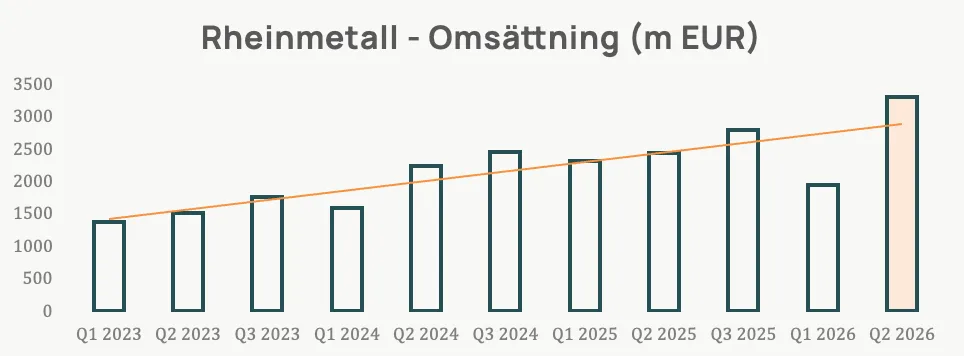
Several companies are reporting higher volumes, improved margins and stronger earnings. In many cases, order backlogs have reached record levels. Rheinmetall’s preliminary Q2 results provide a clear example. Revenue increased by 69%, while operating profit was approximately 20% above market expectations. [1]
The demand is long-term. It is clearly visible in the order books. We remain positive about the sector, but selection is becoming more important. We prioritize companies that can convert financed demand into deliveries, margins and cash flows.
For many companies, the first half of the year was characterised by weak share-price performance and high volatility. As a result, valuations across the sector have become more attractive. Given the unstable geoeconomic environment, volatility is likely to remain elevated. However, because the sector has entered a new phase of growth, there are favourable conditions for a recovery in share prices. Considering the structural growth that we expect over the next ten years, the sector remains a highly relevant allocation within a long-term investment portfolio.
The sector also has a low correlation with the broader equity market, meaning that exposure to the sector can contribute to effective portfolio diversification.
In this report, we focus on the factors we believe will be most important during the sector’s next phase.

01. From budget to delivery
The defense industry's next growth phase
Faster government procurement and increased transparency, combined with companies investing in greater production capacity and in-demand capabilities, are helping to reduce bottlenecks and delays across the system. The question now is which companies can increase production, secure their supply chains and generate profitable growth.
Leading reports from BCG and McKinsey point to the same challenge for European companies. Europe needs to produce more defence equipment, and it must do so faster. This will require less fragmentation, better planning and clearer demand signals from governments. Our analysis of the sector therefore increasingly focuses on the balance between contracts, capacity and profitability. The table below summarises this analytical perspective and the signals provided by companies in their quarterly reports. [2][3]
| Driver | Investor focus | Q2 signal |
| Order intake | Multi-year agreements and long-term sustainable government funding | Record orders provide good visibility. Political control remains a risk. |
| Capacity | New production lines, higher production rates and critical supply chains | New factories are being brought into operation. Bottlenecks among suppliers and in access to skilled labour are easing. |
| Technology | Autonomy, cyber, sensors, space and software. | Acquisitions and partnerships speed up integration. |
| Profitability | Volume, margins, cash flow and return on investment. | Better leverage and future cash flows. The differences between companies are increasing. |
McKinsey estimates that major European defence companies and defence electronics companies have order backlogs equivalent to approximately 3.7 times their annual revenue. This provides strong visibility. At the same time, only 49% of major European platform contracts are awarded to European or domestic suppliers. This demonstrates both the existing capacity gap and the potential for local growth. [3]
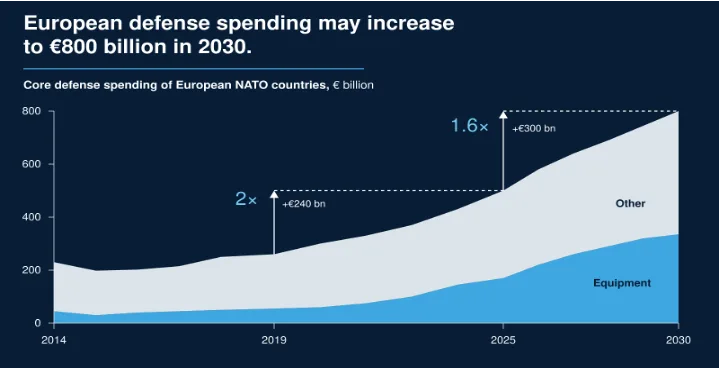
Source: McKinsey (2026) [3]
02. Capacity becomes the next competitive advantage
Production Capacity: Investments Are Under Way and Having an Impact:
Capacity expansion has moved from planning to implementation. Higher production rates, new factories, internationalisation and a greater role for specialised suppliers demonstrate that the industry is actively addressing its bottlenecks. The companies capable of increasing production most rapidly will have the greatest opportunity to convert their order backlogs into revenue.
Rearmament is driving investment in ammunition, engines, electronics, testing capacity and personnel. Capacity remains constrained, but expansion has now moved from planning to implementation. Companies are also increasing local production, while subcontractors are becoming increasingly important within the value chain. The table below summarises several important signals from the recently published quarterly reports.
| Increased production rate | RTX more than doubled ammunition production. L3Harris increased Aerojet deliveries by 60 %. GE Aerospace increased LEAP deliveries by 41 %. Hanwha and Hyundai Rotem delivered faster in Poland. |
| New capacity | L3Harris is opening a GMLRS facility with twice the previous capacity. Saab and Northrop are constructing new facilities for weapons, ammunition and Sentinel systems. |
| More local production | Kongsberg is expanding in the United States, Australia, Norway and Poland. Indra is opening a facility in Kansas. Local production is becoming increasingly important in export contracts. |
| Subcontractors | Kitron and NOTE demonstrate how electronics manufacturers and contract manufacturers are becoming more important as major defence companies (primes), need to scale more rapidly. primes) needs to scale faster. |
Defence companies’ revenue can vary significantly between quarters. The timing of deliveries and project milestones plays an important role. Nevertheless, Rheinmetall’s Q2 results demonstrate what happens when capacity, orders and deliveries converge. Higher production and the completion of previously delayed deliveries had a clear impact on revenue. The long-term trend remains strong, as shown in the chart below.
03. Q2 Shows Which Companies Can Deliver
Order intake and higher delivery volumes strengthen the growth outlook
The reporting season shows that earlier orders are now beginning to translate into deliveries, margins and cash flows. The differences are widening between companies capable of delivering and those still constrained by bottlenecks.
Q2 shows higher deliveries, better margins and record order books. The table below presents a brief summary of the reports for five important European defense groups
| Companies and period | Results | Orders | Key message |
| Rheinmetall Q2 preliminary. | Revenue €3.29 billion, +69% %. Operating profit €562 million, approx. 20% % above consensus. | Order backlog exceeding €80 billion. Continued capacity expansion. | Higher volumes and capacity are delivering a clear improvement in earnings. |
| Saab Q2 2026 | Organic sales growth +29.8 %. EBIT up +41 %. | Order book SEK 318 billion. Major capacity plan underway. | Higher deliveries drive growth and margin improvements. |
| KONGSBERG Q2 2026 | Revenue up 31%. EBIT up 49%. Record margin of 16.1%. | Order book NOK 158 billion. Production is being expanded globally. | Capacity and business mix are generating strong operating leverage. |
| Thales H1 2026 | Defense revenue +12.9 %. Adjusted EBIT +9.9 %. | Order intake +22 %. Order backlog €52.4 billion. | Defense drives growth and better profitability. |
| Dassault Aviation H1 2026 | Revenue +46 %, 18.1 % above consensus. | Order backlog of €45.4bn. A total of 291 aircraft, including 208 Rafale aircraft. | The order backlog is beginning to convert into deliveries. |
04. Asia Demonstrates the Value of Rapid Delivery
South Korean Companies Are Strengthening Their Global Position
Rearmament is a global trend, and South Korean companies are strengthening their position through rapid serial production, competitive lead times and local manufacturing in customer markets. Their strategy combines rapid delivery capabilities with long-term industrial partnerships.
The defence sector’s transition to a new phase of growth is not limited to Europe. In Asia, higher defence budgets and export orders are also beginning to translate into production and deliveries. South Korea stands out in particular. The following three South Korean defence companies have demonstrated a strong ability to expand internationally.
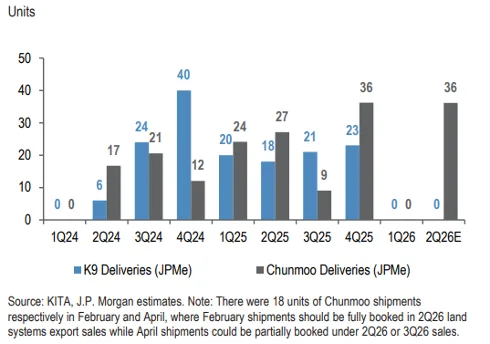
Hanwha Aerospace is continuing to strengthen its European position in artillery and long-range strike capabilities. The K9 and Chunmoo programmes combine deliveries from Korea with local production, maintenance and ammunition manufacturing in Europe. During the spring, Hanwha also signed an additional contract for K9 systems for Finland. The contract was valued at approximately KRW 940bn. The chart below shows deliveries under the two programmes since 2024.
Hyundai Rotem illustrates the same competitive advantage. An initial batch of 28 K2 main battle tanks was shipped to Poland at the end of June, ahead of the original schedule. A further 30 tanks were expected to follow during the summer. At the same time, the company is preparing for local production of the K2PL together with Poland’s Bumar-Łabędy. This model combines rapid initial deliveries with technology transfer and a long-term industrial presence in the customer’s domestic market.
Korea Aerospace Industries also has a growing export pipeline. The KF-21 programme is moving from development towards production, while cooperation with Indonesia continues. Discussions include the potential export of 16 aircraft. However, this should still be regarded as a prospective transaction rather than a firm order.
Estimated K9 & Chunmoo deliveries
05. The Technological Shift Will Be Determined by Integration, Not Individual Innovations
Innovation and Adaptation to Newly Prioritised Capabilities Will Be Key
Defence innovation is increasingly about the ability to connect sensors, data, software and effectors into operationally useful systems. System integration is therefore becoming increasingly important. Small and large companies will complement one another in a sector that needs to deliver new systems rapidly and integrate them with existing capabilities. The winners will be the companies and partnerships that combine technological speed with industrial scale, certification, customer relationships and lifecycle support.
Modern defence capabilities are increasingly built around integrated networks of sensors, data, software and effectors, rather than isolated platforms. Start-ups and specialists are accelerating the pace of innovation, but system integration by major industry participants is required to certify, manufacture and deploy the technology at an operational scale. [4] Relationships with end customers and governments are therefore crucial.
Primes are consequently not being replaced. On the contrary, the Financial Times reported in 2026 that they were investing record amounts to gain access to new technologies. Primes participated in venture capital rounds worth $4.1bn during 2026, while global defence-related transactions had already exceeded $40bn. Internal R&D expenditure among 13 major defence companies is estimated to have increased by more than 25%, reaching $11.6bn between 2021 and 2026. [5]
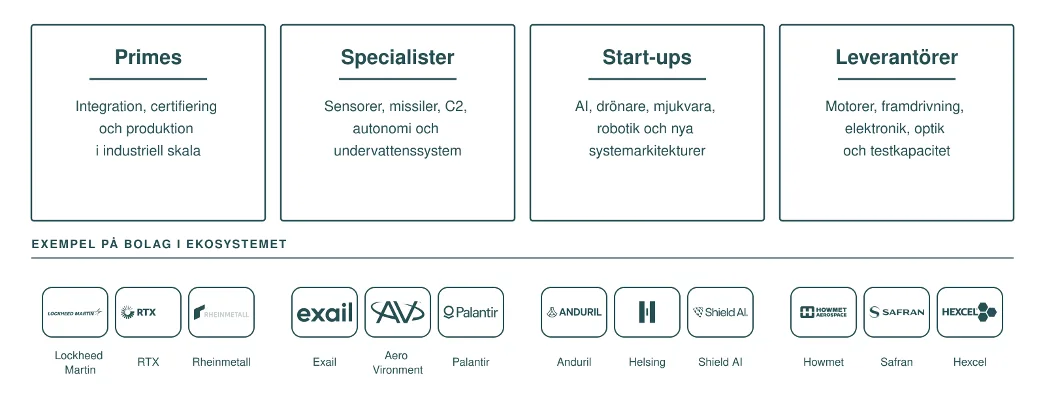
The relevant question is which ecosystems can combine rapid technological development with industrial scale, certification, customer access and lifecycle support. Small, medium-sized and large companies perform different but complementary functions within the same rearmament cycle. This is demonstrated, among other things, by Thales’s planned acquisition of Exail in maritime robotics and navigation, and Lockheed Martin’s acquisition of Ultra Maritime in underwater technology. Acquisitions and strategic investments are therefore becoming a way both to respond to technological shifts and to integrate new capabilities more rapidly into scalable defence systems. [5] Meeting the significant level of demand and rapidly developing new operational capabilities will consequently require close cooperation between smaller technology companies, specialised suppliers and primes.
06. Valuations Create the Conditions for an Earnings-Driven Market Phase
Innovation and Adaptation to Newly Prioritised Capabilities Will Be Key
Defence companies have historically traded at a valuation premium, probably reflecting stronger growth, visible margins and long-term structural demand. In our view, these conditions remain intact and have, if anything, strengthened. Now that this premium has largely disappeared, the sector has a favourable starting point for rising share prices.
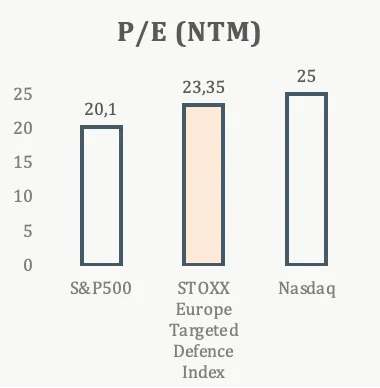
The chart shows that European defence companies are trading at a median forward P/E of approximately 23.35x. This is slightly below the valuation of the technology-heavy Nasdaq. The multiples are not directly comparable, but they indicate that the sector as a whole is not particularly highly valued relative to other quality and growth segments. [6][7][8][11]
An analysis of the US market by RBC Capital provides a more nuanced picture. Major US defence companies were trading at approximately 107% of the S&P 500’s NTM P/E, corresponding to a premium of 7%. At the same time, they were trading at only 77% of the market’s forward P/FCF multiple. The cash-flow valuation therefore appears more attractive than the traditional earnings multiple suggests. [9] In our view, any valuation of the defence sector should take into account the companies’ strong growth, expanding order backlogs, long-term contracts and structural demand. Taken together, these factors suggest that the sector can justify a higher valuation premium.
07. Looking Ahead to the Second Half of 2026
Execution Takes Centre Stage in Fundamental Company Valuation
Ahead of the second half of 2026, the sector’s fundamentals remain strong. However, the market is likely to place a clearer premium on execution, margin improvement and cash flows than it has previously. The quarterly reports show that investments in production capacity are beginning to result in higher deliveries and improved profitability.
Attention is now turning to companies’ ability to meet their delivery schedules, improve margins and strengthen cash flow. New factories are being brought into operation, production is becoming more international and cooperation between primes, specialists and technology companies is deepening. This creates scope for continued growth and positive earnings-estimate revisions.
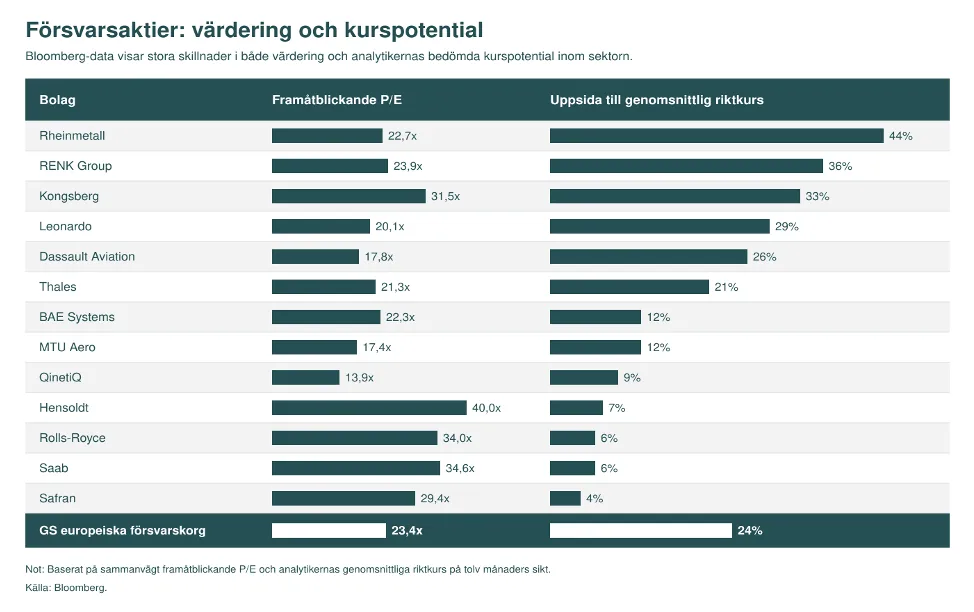
The European defence sector has underperformed the broader market so far this year, despite resilient earnings estimates. Analysts expect annual earnings growth of 20–30% until at least 2028 and, on average, see approximately 25% upside to their target prices. At the same time, the sector’s valuation premium relative to the STOXX Europe 600 has decreased significantly. The divergence between share-price performance and expected earnings growth has therefore created an attractive starting point for a recovery. [10]
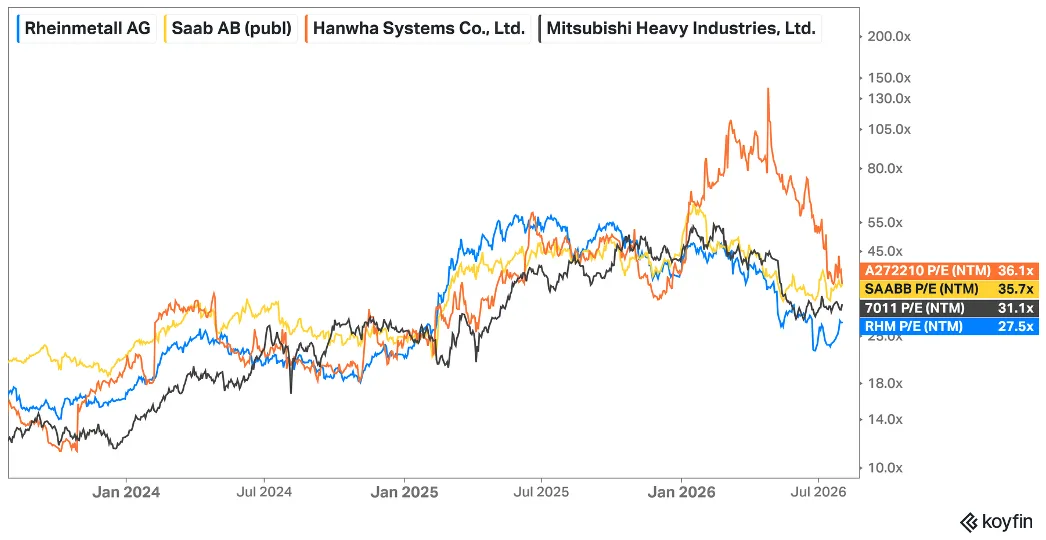
Performance is likely to continue to vary between companies, but volatility may create attractive entry points. We therefore enter H2 with a clearly positive outlook. The next stock-market phase is expected to depend less on multiple expansion and to be driven to a greater extent by growing earnings and cash flows as record order backlogs are converted into deliveries.
Summary
Stronger Fundamentals, Record Order Backlogs and Lower Valuations Than Before
Q2 results show that the industrial ramp-up is now beginning to have a clear impact on deliveries, earnings and margins. As order backlogs continue to translate into earnings and cash flows, we see favourable conditions for the next phase of equities in defence.
The greatest potential lies with companies that can combine high growth with strong delivery capabilities and a product offering adapted to a combination of traditional and newly demanded capabilities
The central conclusion of this report is that the defence sector has moved beyond the initial phase of budget-driven multiple expansion and is now entering a more demanding, but potentially more sustainable, phase. Order backlogs are substantial, demand is structural and quarterly reports show that investments in capacity are beginning to produce visible results. At the same time, differences between companies are becoming increasingly apparent. In the next phase, simply having exposure to rising defence budgets will not be sufficient. The decisive factors will be companies’ ability to scale production, manage supply chains, integrate new technologies and convert funded demand into margins and cash flows.
Our conclusion therefore remains positive but selective. The defence sector has attractive long-term drivers and a more favourable valuation environment, but the greatest potential lies with companies capable of demonstrating that strong demand can genuinely be converted into profitable growth.
References
| 1. Rheinmetall Aktiengesellschaft: Q2 significantly exceeds market expectations with record revenue growth and earnings. 29 July 2026 | 6. BlackRock. iShares Core EURO STOXX 50 UCITS ETF portfolio characteristics, 17 July 2026. |
| 2. Boston Consulting Group. Europe's Defense Challenge Is Also a Manufacturing Challenge, July 17, 2026. | 7. Nasdaq Market Intelligence. June, Second Quarter 2026 Review and Outlook, 1 July 2026. |
| 3. McKinsey & Company. Scaling Security: Building Today. Securing Tomorrow, February 2026. | 8. BlackRock Investment Institute. Tech rally grounded in fundamentals, June 2026 |
| 4. GSB Research. Unmanned Aerial Vehicles Industry Report, research copy 27 July 2026. | 9. RBC Capital Markets. Aerospace & Defense 2Q26 Large-Cap Preview, July 21, 2026. |
| 5. Financial Times. Defense giants provide record backing for military start-ups, 26 July 2026. | 10. Bloomberg, Defense Earnings Back Case for Strong Second Half. 31 July 2026. |
| 11. FactSet. P/E NTM, STOXX Europe Targeted Defense Index. 2026-08-03 |
This text has been published by Finserve Global Defence & Security Fund and is intended for information purposes only.
The content does not constitute investment advice and is based on publicly available sources that Finserve considers reliable, as well as the fund’s own assessments. Finserve accepts no liability for any direct or indirect loss or damage arising from the use of this information.
Past performance is not a guarantee of future results. The value of an investment in the fund may rise or fall, and investors may not recover the full amount invested. The content should not be regarded as legal or tax advice. Prospective investors should consult their own professional advisers before making an investment decision.